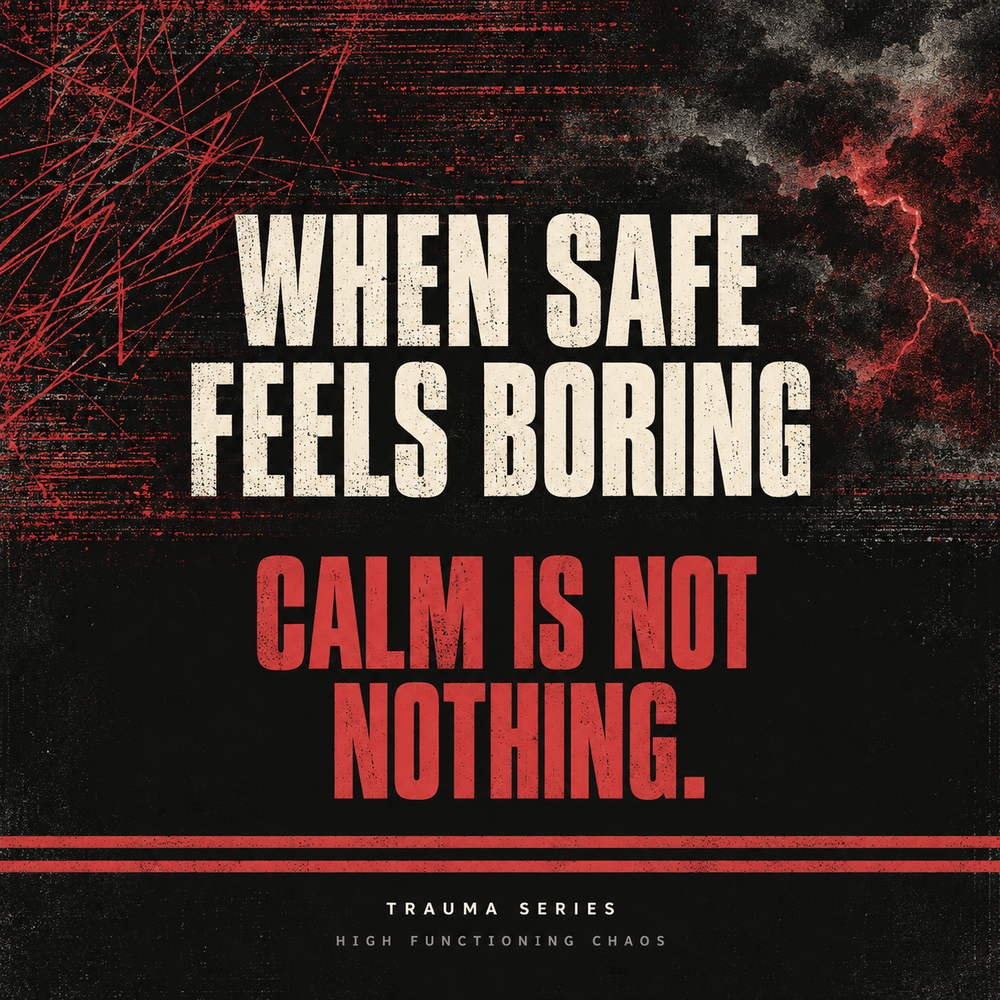
There is a thing nobody explains well when you come from chaos: safe can feel boring.
Not peaceful. Not easy. Boring.
When you grew up with abusive parents, your body learns that love can come with yelling, control, walking on eggshells, trying to read somebody’s mood before they even open their mouth, and figuring out how to take up as little space as possible. Then you carry some version of that into adulthood. For me, that included abusive partners too. Different people. Same familiar bullshit: waiting for the switch, trying to fix the temperature in the room, mistaking intensity for proof that something mattered.
So when life is calmer, when somebody is consistent, when there is no screaming or punishment or emotional obstacle course to complete before you get basic kindness, part of your brain can look around and go: “Okay, but where is the catch?”
Sometimes it goes one step further: “Is this even real if it does not hurt?”
That is not because you secretly want to be mistreated. It is because your nervous system learned what it had to learn to survive. Research on childhood maltreatment shows that early adversity can shape threat processing, emotion regulation, and attention in ways that make hypervigilance understandable in the environment it was learned. McCrory et al., 2017
If you are neurodivergent, there can be even more layers on that pile. Maybe you already notice more. Maybe you feel emotions at full volume. Maybe you spent years masking, being misunderstood, getting told you were too sensitive, or trying to figure out what everybody else meant without receiving the damn instruction manual. Trauma symptoms and neurodivergent traits can overlap, which is one reason it helps to look at the full picture instead of trying to diagnose yourself from one bad Tuesday. Research on trauma in autistic people also makes clear that assessment and support often need to be adapted rather than treated like one-size-fits-all. Peterson et al., 2019
For a long time, I thought calm meant something was missing.
No fight to solve. No sudden cold shoulder to decode. No major apology after somebody broke me down. No huge emotional high after the low.
Just regular life.
And regular life can feel suspicious as hell when your body is used to scanning for the next thing.
Calm is not the same as numb
This part matters. A safe relationship should not mean you disappear, settle for emotional distance, or call neglect “peace.” You still get to want affection, fun, intimacy, honesty, sex, laughter, challenge, and a relationship that feels alive.
The difference is that real connection does not need fear as fuel.
Safe can include disagreement without threats. It can include boredom without abandonment. It can include a hard conversation without spending the next three days trying to figure out if you are about to be punished for having one.
It takes time for your nervous system to learn that there is a middle ground between chaos and nothing.
How I am trying to make safe feel less “boring”
- Name the feeling before giving it the microphone. When I feel restless, disconnected, or like I need something big to happen, I try to ask: “Am I actually bored, or am I uncomfortable because things are calm?” Those are not the same problem.
- Build safe novelty on purpose. Go somewhere new. Try a project together. Plan a date. Learn something. Have the spontaneous conversation. A relationship does not need a crisis to have energy.
- Do not manufacture a fight to prove the relationship is real. This one is rough. Sometimes an old survival brain will poke at peace just to see if it is still there. Pause before sending the loaded text, picking a fight, shutting down, or testing somebody’s loyalty.
- Practice saying the actual need. “I need reassurance” is a lot more useful than acting like you do not care until you explode. “I am feeling distant and could use some time together” beats creating an emergency just to get someone’s attention.
- Let consistency count. Notice the boring-good things: they follow through, they respect a no, they do not punish honesty, they do not make you pay for a bad day. That is not lack of passion. That is evidence.
- Get support that does not treat you like a broken appliance. Trauma-informed support, especially from someone who understands neurodivergence, can help you separate what your body learned from what you actually want now.
None of this means you should stay in a relationship that feels empty or unsafe. Calm is not an excuse for control, neglect, or abuse. If there are threats, coercion, stalking, isolation, violence, or fear, that is not healthy “boring.” That is a safety issue. The National Domestic Violence Hotline offers confidential support and safety-planning tools at thehotline.org or 800-799-SAFE (7233). If you are in immediate danger, call 911.
But if your relationship is safe and your body keeps waiting for the other shoe to drop, it may not mean the connection is wrong.
It may mean you are learning that you do not need to earn love by surviving it.
This post is for reflection and education, not a diagnosis. If trauma symptoms are making daily life hard, a trauma-informed mental-health professional can help.