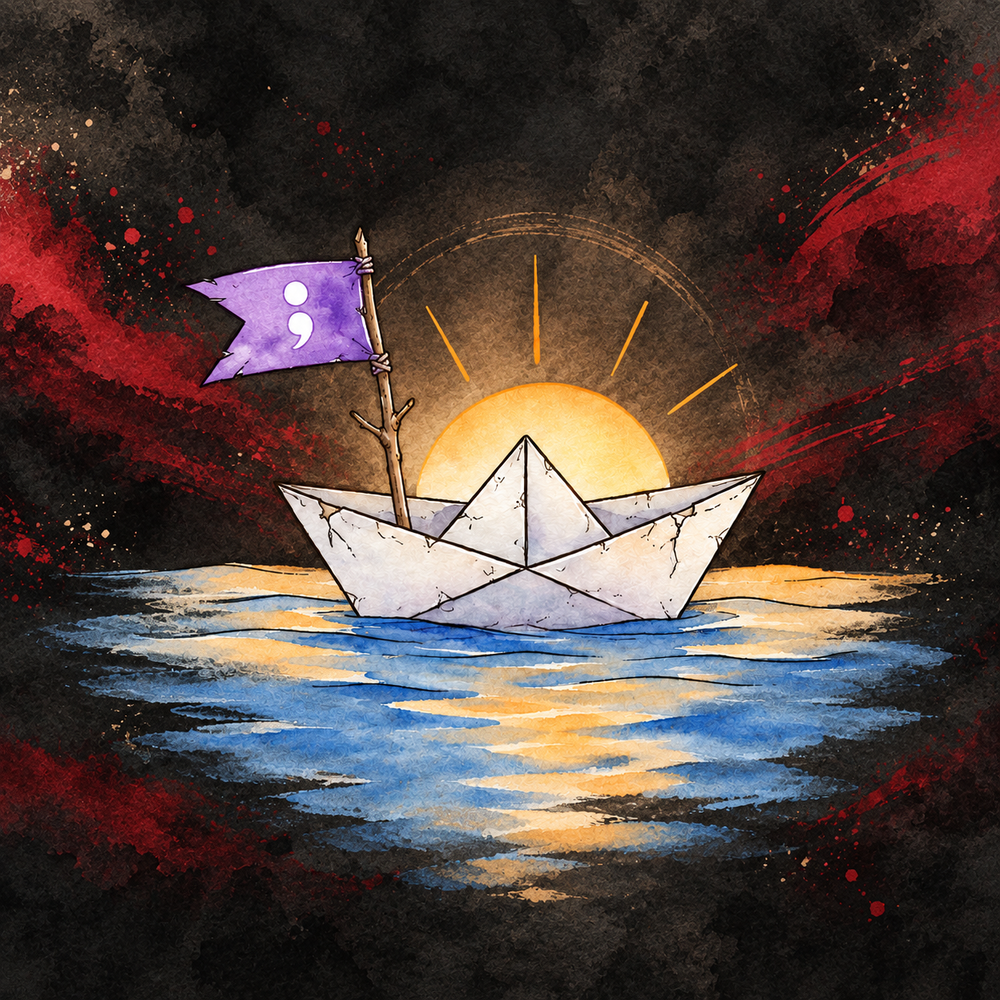
Content note: This post discusses suicide, loss, suicidal thoughts, and crisis support.
We are halfway through September, Suicide Prevention Awareness Month, and it feels like the right time to talk about something I have carried for more than two years.
This is part of the anniversary of me continuing my story.
In March 2024, I attempted suicide.
I am still here. Not because everything suddenly got easier, not because I found some perfect answer, and not because surviving made me instantly grateful for every hard thing that came after. I am here because I stayed. For my kids. For the people I loved. For the chance that life could still hold something besides the moment I was trapped in.
I have had suicidal tendencies since I was younger. Ironically, I was listening to Suicidal Tendencies as a kid, which feels like a pretty crude joke now.
But it was never really a joke.
When you are young and your head is already loud, dark thoughts can start to feel like part of the background noise. You do not always have words for it. You do not always understand that what you are feeling is something you can say out loud. Sometimes you just learn how to push through, joke through it, shut down, or make yourself useful enough that nobody looks too closely.
That is how a lot of us get missed.
I have been around suicide for a long time
In 2010 and 2011, I lost more than eight people to suicide.
One of my friends died by suicide in 2011. A few hours later, I went to his house to collect personal belongings. Being confronted with the aftermath brought me right back to when I was 14 and witnessed the last moments of my cousin after he died by suicide.
I have been around it since I was young. I have seen what it does to families, friends, homes, and the people left trying to make sense of something that does not make sense.
Those losses are part of what pushed me to become ASIST certified. I wanted to know how to recognize the signs, sit in the hard conversations, and help somebody find the next step. I believed that if you caught someone at the right moment, asked the right questions, and stayed with them long enough, you could make a difference.
And I have been able to help a few people.
Then March 2024 happened.
From the outside, I probably looked normal
From the outside, life probably looked normal. At the same time, it was not.
My family and I were living with a friend after needing to find a new home. I was driving an hour each way to work, not making enough money, raising kids, and getting hit with one outside stress after another. It felt like there was no room to catch my breath before the next thing showed up.
I was functioning. I was showing up. I was doing what I was supposed to do.
But I was physically there and mentally somewhere else.
I spent too long shutting down and trying to look elsewhere for relief. It was not helping. The bees in my head would not stop. Everything felt fogged up and poisoned by my own thoughts, and that is a dangerous place to be when you are already not okay.
The part that brought the most shame was knowing I had the training.
I had helped other people. I knew the questions to ask. I knew that someone could look “fine” while being nowhere close to fine. But when I got to that point myself, none of that training felt accessible. I could not see myself clearly enough to save myself. I did not reach out first.
I was angry at myself for that.
But knowing the signs does not make you immune to reaching that point. Being the person who helps other people does not mean you automatically know how to let people help you. Sometimes the people who are good at holding everybody else together are the worst at admitting they are falling apart.
Neurodivergence can make the noise louder
“Neurodivergent” is a wide umbrella. It can include ADHD, autism, learning differences, and other ways a brain can process the world differently. It is not one diagnosis, and it does not mean someone is weak, broken, dangerous, or destined for suicide.
It also does not mean trauma causes ADHD or autism. It does not.
But neurodivergence can add layers when someone is already overwhelmed.
For me, there is the constant noise. The bees. The thoughts that do not line up politely and wait their turn. The exhaustion of trying to keep up with responsibilities, money stress, parenting, work, relationships, and life while your brain is already running seventeen tabs in the background.
For other people, it can be masking all day so nobody sees how overwhelmed they are. It can be rejection sensitivity, impulsivity, sensory overload, social isolation, bullying, burnout, depression, anxiety, trauma, or being misunderstood so often that eventually you stop trying to explain yourself.
None of that automatically leads to suicide. But it can make it harder to get help early—especially when the person looks “high functioning” enough that everyone assumes they are okay.
And the numbers are not small.
A 2023 meta-analysis of autistic and possibly autistic people without co-occurring intellectual disability found that 34.2% had experienced suicidal thoughts, 21.9% had made a suicide plan, and 24.3% had experienced suicide attempts or suicidal behavior. The same paper notes that general-population estimates are roughly 9% for suicidal thoughts and about 2–3% for plans or attempts. Those are study-level estimates, not a prediction for any one person, but they make one thing clear: this needs to be taken seriously. Read the meta-analysis.
For ADHD, a systematic review and meta-analysis found higher odds of suicidal thoughts, plans, and attempts compared with people without ADHD. In that review, the odds of suicide attempt were about 2.4 times higher and the odds of suicidal thoughts about 3.5 times higher. Read the ADHD review.
That does not mean being autistic or having ADHD is the cause. Research does not give us permission to simplify it that way. Risk is shaped by a lot of things: depression, anxiety, trauma, isolation, financial stress, substance use, access to care, discrimination, relationships, and whether somebody has support that actually fits how their brain works.
The point is not to label neurodivergent people as a problem. The point is to stop missing people because they do not look like the version of “in crisis” we expect to see.
“Are you okay?” is not always enough
I do not blame anyone for not seeing what was happening with me. Everybody has their own lives and their own shit going on.
Still, I wish someone had asked a second time.
Not just, “Are you okay?” followed by, “Okay, you’re fine.”
I wish somebody had slowed down and said, “No, really. You do not seem like yourself. What is going on?”
Sometimes “I’m good” means, “I do not know how to tell you how bad this is.”
Sometimes “I’m tired” means, “I have not slept because my brain will not stop.”
Sometimes “I just need space” means, “I am scared of what I might do if I am alone with my thoughts.”
You do not have to interrogate somebody or become their therapist. But you can ask twice. You can sit with the discomfort. You can say, “You do not have to explain it perfectly. I am here.”
That second question might matter more than you know.
Talking about it is part of breaking the stigma
One of the reasons I am saying this out loud is because silence does not protect us. It isolates us.
I recently spoke with a young man about half my age who survived a recent attempt. Being able to tell him that I had been there too—that he was not alone, that he was not broken, and that it was okay to talk about it—mattered.
Suicide is treated like a taboo subject until somebody dies, and then everyone asks what they could have done differently. We need to be able to talk before it gets there.
Talking openly about suicide does not mean glorifying it. It means taking away some of the shame that keeps people trapped inside their own head. It means making room for somebody to say, “I’m not okay,” without worrying that they will be judged, dismissed, or treated like a problem.
Honestly, it takes more strength to say the hard thing out loud than it does to stay silent and suffer alone.
What kept me here
I stayed for my kids. For my wife at the time. For life itself—for the chance to keep experiencing things, good or bad.
Not because everything suddenly became okay. Not because one conversation fixed the whole thing. I stayed because there were still people I loved, still moments I had not lived yet, and some part of me knew that a permanent decision should not get to be made by the worst version of one of my days.
Cannabis can sometimes quiet the noise for me. It can lower the volume on the bees for a minute. But I do not want to pretend it fixes the wound. If I use it to avoid dealing with what is underneath, it is just a Band-Aid over a bullet wound.
Relief matters. So does actually getting help.
That can mean a friend, a therapist, a support group, a doctor, a crisis counselor, a spouse, a family member, or someone who will sit with you without requiring you to perform being okay first.
If you are reading this at 2 a.m.
If you are reading this in the middle of the night and your brain will not stop, you are not alone.
You do not have to prove that you are in enough pain before you deserve help.
You do not need the perfect words.
You can say:
- “I’m not okay.”
- “I need someone to sit with me.”
- “I’m scared of what my mind is telling me.”
- “I do not know what I need, but I do not want to be alone.”
If you are in the U.S. and thinking about suicide, worried about someone, or simply need somebody to talk to, call, text, or chat 988 to reach the Suicide & Crisis Lifeline. If there is immediate danger, call 911 or go to the nearest emergency room.
And if you know me personally and need someone to hold space while you say the hard part out loud, reach out. I cannot promise I will have the perfect answer, but I can listen without judging. If you are in immediate danger, call or text 988 or call 911.
Ask again.
Stay with people.
And if you are the one carrying it: still here matters.
This is a personal reflection, not medical advice or a substitute for professional care. Neurodivergence does not cause suicide, and statistics cannot predict what any one person will experience. If you are struggling to stay safe, reach out for immediate support.