What comparing our childhoods has taught me about patience, fear, and owning my mistakes.
My kids make a mess, and they come tell me.
Something spills. Something needs cleaning up. They need help figuring out what to do next. From Nevaeh at 17 to Jefferson at 3, they ask.
That might sound like a small thing. To me, it fills my cup.
Because I remember what it felt like to need help and have to consider whether asking was going to make things worse.
Being a kid at the wrong moment
Growing up, asking for help or wanting to do something at the wrong moment could mean being ignored or screamed at. Help could come with guilt, or the feeling that I now owed my mother or stepdad something.
I was a kid with AuDHD. Sometimes I needed help. Sometimes I interrupted. Sometimes I made a mess. Those ordinary parts of being a kid could turn into something much bigger.
I experienced yelling, being talked down to, and physical punishment. Spilling a bowl of chili on the carpet could lead to being physically hurt. Those experiences stayed with me long after the mess was gone.
I have forgiven my mother for being young while raising me. I can recognize that she had things of her own to work through. From my perspective, some of the anger she carried toward my biological father and other people landed on me.
Understanding that hasn’t changed the fact that lines were crossed. There were things I promised myself I would never do to my own kids.
The differences show up in ordinary days
When I compare my childhood with theirs, I notice more than how discipline works.
I think about taking the kids to school together. Stopping at daycare, then Alexander’s school, and sometimes Nevaeh’s. Everybody making the rounds together.
For me, getting to school meant walking alone or taking the bus. There’s nothing inherently wrong with either. But those shared trips are one of the everyday differences I notice between their childhood and mine.
I also allow my kids mental-health breaks. Growing up, if I missed school and wasn’t sick, I was made to do physical labor. That’s another difference in how I approach what my kids might need.
And then there’s asking for help. My kids do that regularly, without being ridiculed for needing it. They don’t have to earn the right to ask by making sure I’m in exactly the right mood.
There are still expectations
If my kids make a mess, I encourage them to take care of it. I want them to try on their own. If they need help, they can ask.
I have AuDHD too. Switching gears isn’t always instant. Sometimes I need a minute to finish what I’m doing before I can help, and I tell them that. An emergency is obviously different.
Nevaeh helped me develop a lot of the patience I have today. Part of that has been learning not to lose my cool over the small things that would have set off my mother or stepdad.
I’m not going to pretend I never raise my voice. Sometimes I yell to get their attention when things are completely off the rails. But I don’t physically punish them or talk down to them. I don’t want a spilled drink to turn into an attack on the child who spilled it.
There’s a mess to handle. We can handle it.
Learning the words for what I was seeing
I noticed these differences years ago, but I couldn’t quite put my finger on all of them. Going back to school, studying psychology, and working alongside BCBAs helped me put language to what I was seeing.
One concept was the parent-child coercive cycle.
In simple terms, the immediate relief of ending an uncomfortable interaction can reinforce the behavior that ended it. A child escalates, an adult gives in, and the argument stops. An adult gets louder, the child goes quiet, and yelling appears to work. Over time, those responses can become more likely because they worked in the moment.
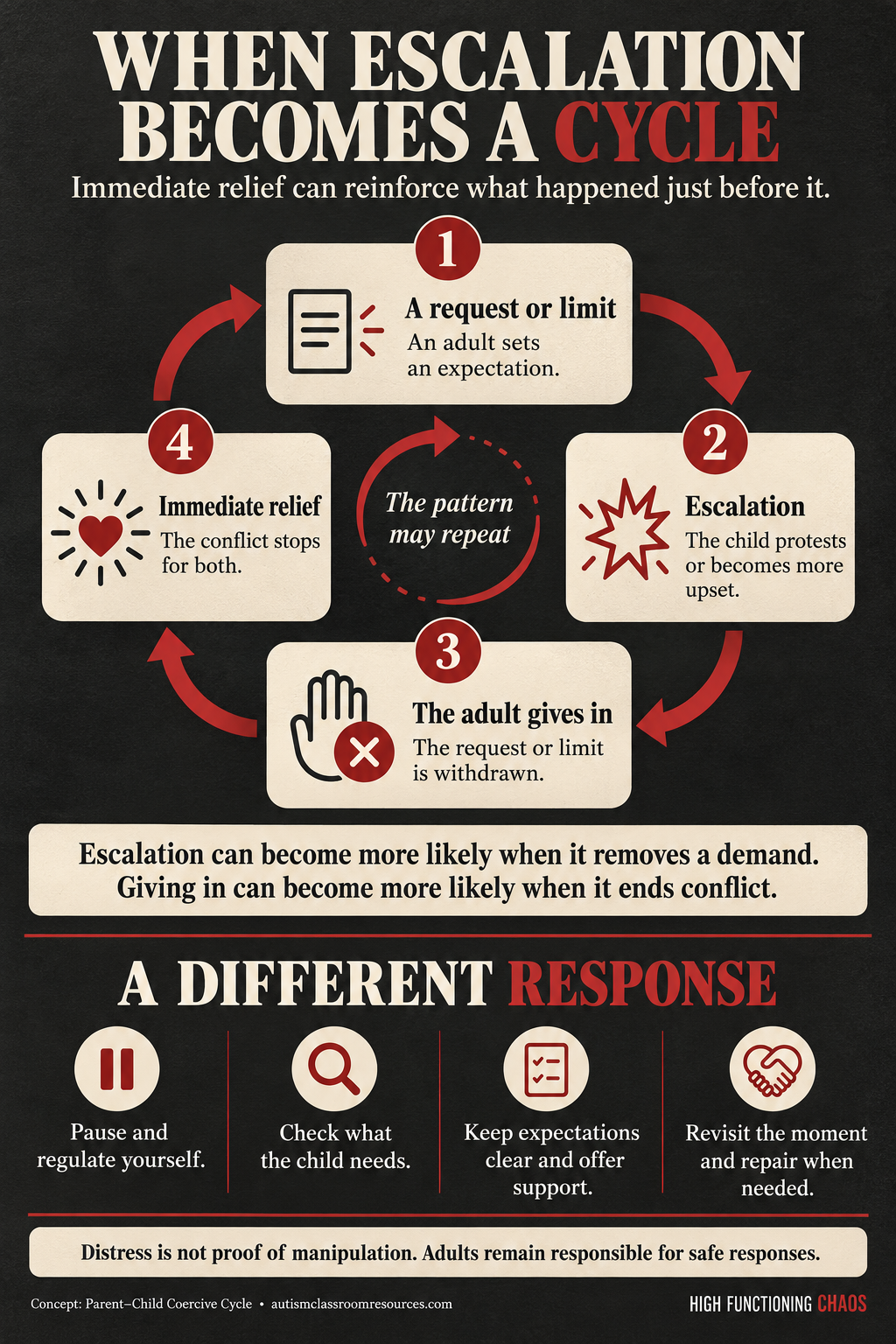
The parent-child coercive-cycle resource helped give me a framework for thinking about that pattern.
It doesn’t explain every family experience, and it doesn’t make a child responsible for an adult hurting them. That responsibility belongs to the adult.
But it does give me a question worth asking about my own parenting: what am I teaching beyond getting through this moment?
When my kids spill something, I want them learning how to clean it up and ask for help. I don’t want them spending that moment figuring out how to hide it from me.
I have to own my mistakes, too
Recently, I snapped at Monica over something involving the littles while Nevaeh was there.
I apologized to Monica. I also told Nevaeh that what I did wasn’t right and that I had let my emotions get the best of me.
I didn’t want to leave that interaction sitting there as though my response was normal or acceptable just because I was the adult.
I expect my kids to take responsibility when they make a mistake. That expectation has to apply to me, too. They need to see what accountability looks like when I’m the one who got it wrong.
Apologizing doesn’t undo the moment. It does let me acknowledge it honestly instead of expecting everyone to pretend it didn’t happen.
Why it fills my cup
My kids come to me.
They ask for help. They tell me when they’ve made a mess instead of hiding it. Across their different ages, that’s something I get to see again and again.
Watching them do that, I see a difference from the fear I remember carrying as a kid. I can’t know everything going on inside their heads, but I love that they’re willing to bring things to me.
They still need to try. They still need to clean up after themselves. Sometimes they need to give Dad a minute to switch gears.
And when I get something wrong, I need to own it.
I want them to keep knowing they can come to me, even when something has gone wrong.
A mess can be cleaned up. I’m glad they don’t feel the need to hide it first.