There’s a thing people joke about a lot: “out of sight, out of mind.”
Leave something in a drawer and it may as well have entered witness protection. Put important paperwork under another piece of paper and suddenly it has vanished from the known universe. Move the laundry basket out of the hallway and apparently it is no longer my responsibility.
People sometimes call that “object permanence,” but that is not really what I mean.
I know the thing still exists.
I know the bill is due. I know I need to reply to the email. I know there is an appointment to schedule, a prescription to refill, paperwork to submit, a phone call I have been avoiding, or some tiny task that will become a huge task if I ignore it long enough.
The problem is not that I think those things stop existing when I cannot see them. The problem is that knowing something exists and being able to keep it present enough to do something about it are completely different things.
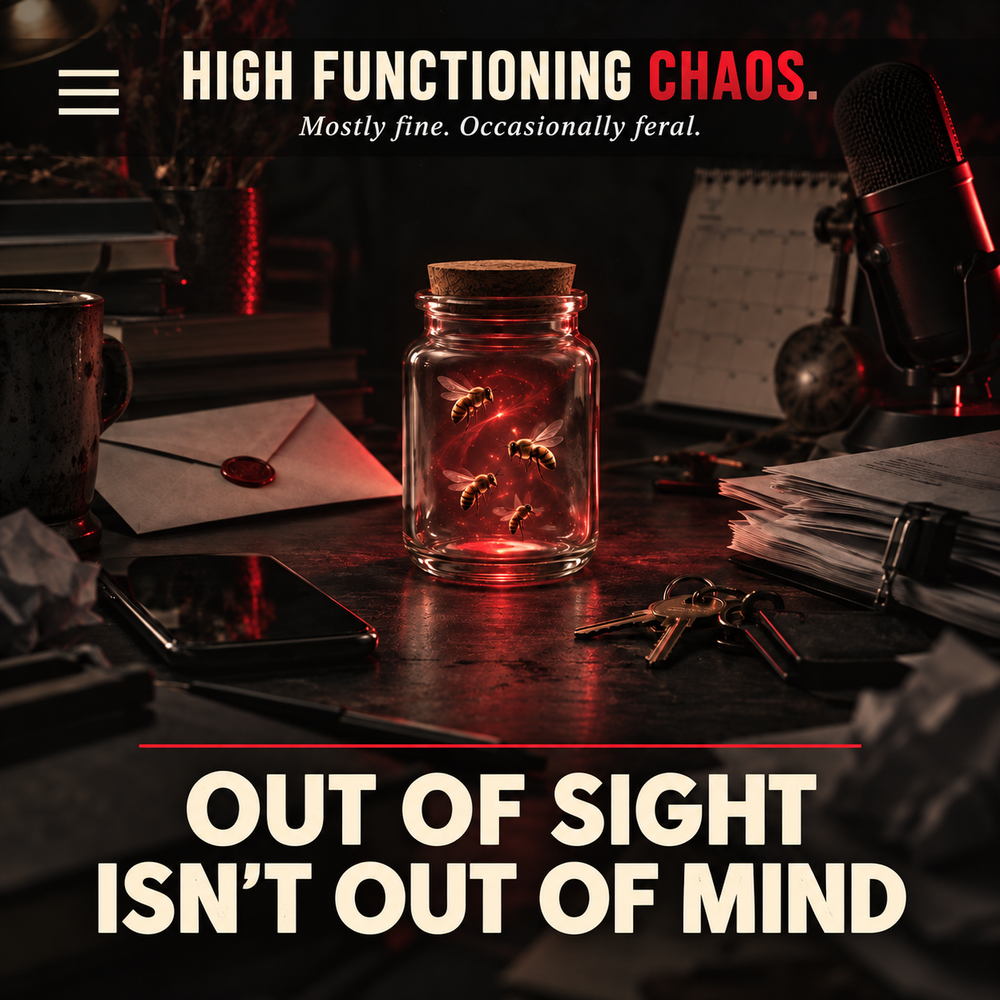
For me, working-memory challenges and executive dysfunction can make life feel like everything depends on whether the jar of bees in my brain is calm enough to hold onto one thought before three other thoughts run into it wearing tiny clown shoes.
And it is not always little stuff.
Sure, sometimes it is walking into a room and forgetting why I went there. Opening my phone to text somebody, seeing one notification, and resurfacing twenty minutes later after researching whether raccoons can open jars.
But it can also be the form connected to school, housing, health, money, work, family, or an opportunity that could actually change something important.
It can happen to things I genuinely care about
Real life took the driver’s seat with the podcast. It was not that I decided it did not matter anymore or that I gave up on it. Life just got loud, complicated, and full of things that needed attention right then.
The podcast got pushed far enough out of my active focus that it was basically on pause without me ever consciously deciding to pause it.
Then I was working on my VPS one day and ran into something connected to it. That reminder brought the whole thing back into view.
And suddenly I remembered: Oh. Yeah. I care about this. I still want to do this. I did not stop because I did not believe in it. My brain just had to put out the nearest fire for so long that this important thing got buried under everything else.
That is what I mean. Sometimes a project, goal, relationship, appointment, or life-changing opportunity can drift out of sight—not because it is unimportant, but because real life grabbed the wheel and the jar of bees lost the map.
From the outside, it can look like I forgot. Like I did not care. Like I did not try. Like I did not prioritize something that clearly mattered.
Sometimes the truth is that I remembered it seventeen times. I panicked about it twelve times. I meant to do it six times. And I still did not get it done.
Not because it did not matter. Sometimes it is specifically because it mattered so much that it became a loud, complicated, emotionally loaded thing. Then my brain filed it under “we should deal with that,” along with every other unfinished responsibility, random thought, sensory distraction, old embarrassment, and thing I need to Google later.
Eventually the task is no longer just a task. It becomes a whole vibe. A bad vibe.
When a task grows teeth
“Call the doctor” sounds easy until it becomes: find the number, figure out when they are open, remember why you are calling, find insurance information, make sure you can take the call somewhere private, prepare to be on hold, write down what they said, and actually follow through on whatever comes next.
That is a lot to hold in your head for something people casually describe as “just make the call.”
The same thing happens with emails, paperwork, cleaning, grocery shopping, taxes, job applications, returning a package, making an appointment, following up with somebody you love, or taking the first step on a massive life change.
If I cannot see the next step, cannot remember the next step, or cannot figure out where to begin, my brain may treat the entire thing like a locked door.
Then urgency shows up. Sometimes urgency is the only thing loud enough to cut through everything else. The deadline is tomorrow. The bill is overdue. Somebody is waiting. There is a consequence now.
Suddenly I can do in two hours what I could not start for three weeks.
That does not mean I needed the pressure. It means panic finally overpowered the rest of the noise. It is not exactly a sustainable productivity system. It is more like using a flamethrower to light a candle.
The shame loop is not a tool
The default response for a lot of us is shame.
“I should be able to do this.” “Why am I like this?” “Everybody else can handle basic life stuff.” “If I cared, I would have done it.”
That last one hurts, because it sounds believable when you have missed something important.
But shame does not make tasks easier to start. It usually makes them heavier. Now you are not only avoiding an email. You are avoiding the guilt attached to the email. You are avoiding the fear that you waited too long. You are avoiding the possibility that someone will be annoyed, disappointed, or confirm the terrible story you are already telling yourself.
The longer it sits, the bigger it gets.
And then somebody says, “Why didn’t you just do it?”
Friend, if “just do it” worked, I would have built a shrine to Nike years ago.
This is not an excuse to never take responsibility. Things still have consequences. People are still affected. We still have to own it, repair it when we can, and build systems that help us be more reliable.
But beating ourselves up is not the same thing as accountability. One of those can help us move forward. The other mostly makes us want to hide under a blanket and become part of the furniture.
Tools that help me keep life outside my head
The biggest shift for me has been accepting that my brain cannot be the only place important information lives.
That is not failure. That is infrastructure.
Some people can carry a running task list in their head and retrieve it when they need it. Cool. I am genuinely happy for them. My head has the storage capacity of a browser with forty-seven tabs open, two frozen windows, and music playing from somewhere I cannot find.
So I use external supports—not because I am incapable, but because I want less of my life to depend on perfect focus appearing at exactly the right moment.
Make important things visible
If something needs attention, hiding it in a drawer, random app, unopened email, or pile of paper is basically handing it a camouflage blanket.
Leave the return package by the door. Put medicine where you will see it at the right time. Keep a paper planner open where you actually sit. Use a whiteboard for the handful of things that cannot disappear this week.
The point is not to create a wall covered in so much information that it becomes visual wallpaper. The point is to make the next important thing hard to miss.
Write the next physical step, not the whole project
“Deal with insurance” is not a task. It is an intimidating cloud with paperwork inside.
“Open the insurance website and find the member-services number” is a task.
“Clean the kitchen” can feel impossible. “Put the cups in the sink” is a place to start.
When I am overwhelmed, I try to shrink the task until it is almost stupidly specific. Not because I am stupid, but because a vague, giant task gives my brain nothing solid to grab onto.
Use reminders with a purpose
A reminder that just says “DO THIS” at 9:00 a.m. is personally insulting. I know I have to do it. That is why I put it there.
What helps more is a reminder that says what the next step is and arrives when I can realistically act: “After work: sit at desk and upload the document.” “Before leaving: put return package in car.” “Tuesday at 2:00: call the pharmacy. Number is saved here.”
It also helps to give myself more than one chance. Missing one alert should not mean the task falls into a black hole until next month.
Put one trusted place in charge
This does not have to be a fancy productivity system. A notes app, paper planner, calendar, whiteboard, task app, or one notebook can work. What matters is that I know where to look.
The less often I have to think, “Wait, where did I write that down?” the better. Five different systems usually become zero systems. If I have reminders in one app, notes in another, sticky notes around the house, emails flagged for later, and texts sent to myself, I have created an escape room.
One home base is boring. Boring is good. Boring is findable.
Put time next to the task
A task list is helpful. A calendar can be even more helpful when a task needs actual protected time. Instead of “fill out paperwork,” try “Thursday, 6:30–7:00 p.m.: open paperwork and complete page one.”
That does not guarantee I will do it. But it turns an abstract responsibility into an appointment with a beginning and an end. If I cannot finish it, I can schedule the next piece instead of letting it become an unnamed guilt cloud again.
Body doubling is weirdly useful
Sometimes I do not need help doing the task. I need help starting it.
Having another person nearby while I make a call, clean a room, answer emails, or work through paperwork can make a massive difference. They do not have to coach me or fix anything. They can be doing their own thing.
A friend on video chat. Someone at the kitchen table. A quiet “want to tackle our separate stuff together for half an hour?” You are not asking someone to carry your life for you. You are using connection as a support.
Create a landing zone for important stuff
Keys, wallet, medications, mail, school papers, paperwork, chargers—whatever tends to vanish. Give it a home that is visible and easy to use.
The best system is not the prettiest one. It is the one you will actually use when you are tired, distracted, late, overstimulated, or carrying twelve things at once.
A basket by the door might beat a beautifully organized filing cabinet. A clipboard on the fridge might beat a planner you keep forgetting exists. We are building for real life, not for a productivity influencer’s kitchen counter.
Lower the barrier to coming back
Eventually I will miss a reminder. I will forget about the planner. I will ignore the laundry. I will abandon the task list for a week and then feel personally attacked by it.
The old move was to decide I had failed and should probably restart my entire life on Monday.
Now I try to return to the system without making it a trial. Open the list. Pick one thing. Do the next tiny step. No dramatic redemption arc required.
For the people around us
If someone in your life struggles with this, please know that reminding them they forgot something is not automatically wrong. Sometimes we need reminders. We need backup. We need help making the invisible visible.
But there is a difference between a reminder and a character judgment.
“Hey, did you get a chance to call them?” is different from “You never care enough to remember.”
“Want me to sit with you while you start it?” is different from “It will only take five minutes.”
Maybe it would only take five minutes if starting were the only issue.
Sometimes the kindest thing you can do is help break down the first step. Ask what would make the task easier to start. Offer to be present. Put the date in the calendar together. Give grace without taking over.
The point is not to become perfect
I am probably always going to have days where I forget why I opened the fridge, lose an important thought halfway across the room, and discover a task at the exact moment it becomes urgent.
But I am trying to build a life that does not require me to remember everything perfectly in order for things to go okay.
I am trying to rely less on panic. Less on shame. Less on hoping Future Me will magically have more energy, focus, patience, organization, and emotional regulation than Present Me.
I am trying to make the important things visible, smaller, easier to restart, and harder to lose.
Because “out of sight, out of mind” is not always about not caring.
Sometimes it is about trying to hold an entire life together while the bees have the clipboard.
And honestly? They are doing their best.